Heliocentric Ephemeris
A Heliocentric Ephemeris study generates tables of planetary positions as seen from the Sun's center. This perspective shows the true orbital positions of planets in the solar system, free from the influence of Earth's own orbital motion.
Creating a Heliocentric Ephemeris Study
You can create a new Heliocentric Ephemeris study in either of these ways:
- Click the Heliocentric Ephemeris button on the toolbar
- Select Ephemerides > Heliocentric Ephemeris from the menu
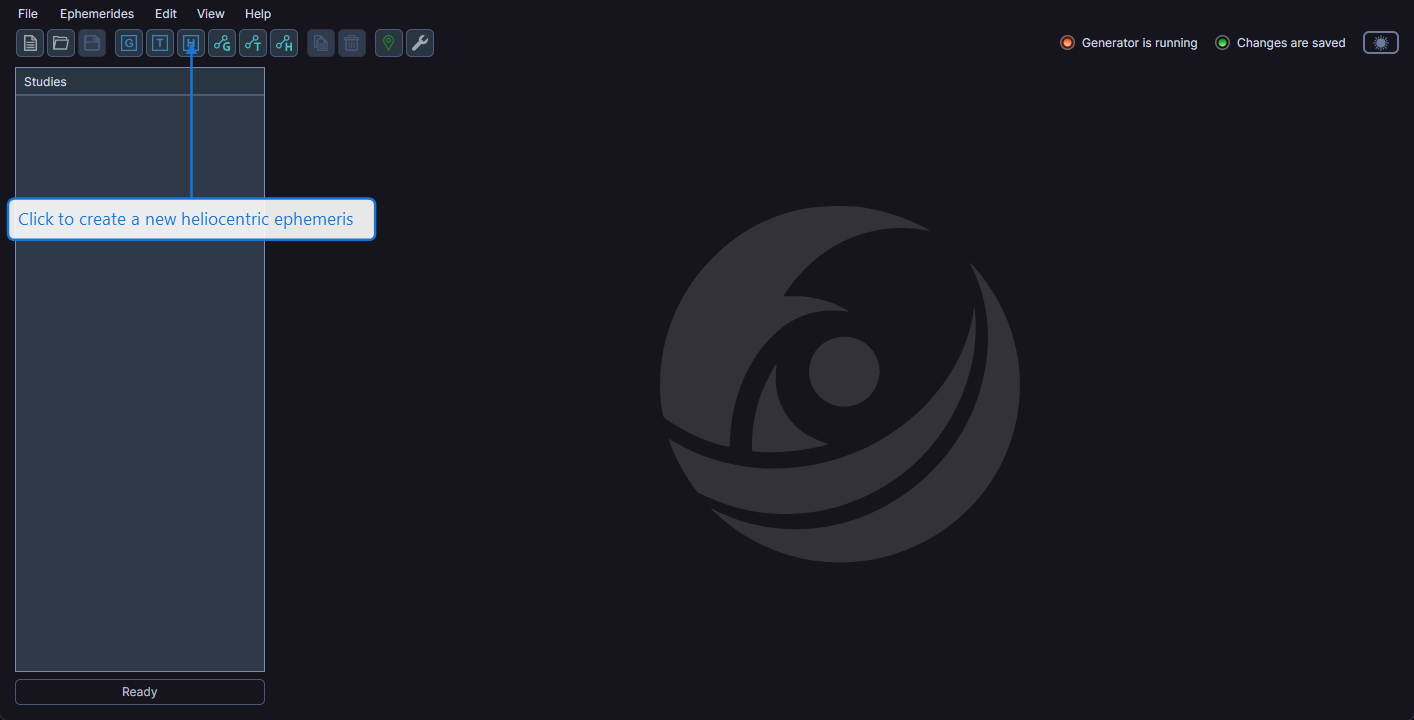
A new study appears in the studies list with its configuration panel displayed.
Configuration
The Heliocentric Ephemeris shares the same configuration structure as other ephemeris studies:
- Study Name, Location, Zodiac, Ref. Plane
- Start Date, Start Time, End Date
- Interval and Time Unit
- Bodies and Metrics lists
The coordinate origin is fixed to Heliocentric. The body list adjusts for this perspective -- for example, the Sun is not available as a body since positions are calculated from the Sun's viewpoint.
When to Use Heliocentric
Heliocentric positions are useful for:
- Studying the true orbital dynamics of planets in the solar system
- Research that requires positions without the apparent retrograde motion caused by Earth's orbit
- Comparing actual orbital distances and angular separations between planets
In a heliocentric ephemeris, planets never appear to go retrograde because the viewpoint is the Sun itself. Retrograde motion is an artifact of the geocentric perspective.